AI accelerators
Important to understand the optimal approach to AI hardware. GPUs? AI accelerators? ARM chips with ai-accelerators built-in? etc.
Who needs separate AI accelerators?
Read and extract from:
Arm is so, so over this AI accelerator unit craze (opens in a new tab)
Section Who needs separate AI accelerators?
Arm licenses its CPU and GPU designs to system-on-chip designers, which themselves can include in their processors their own custom hardware acceleration units for AI code. These units typically speed up the execution of matrix multiplication and other operations crucial to running neural networks, handily taking that work away from the CPU and GPU cores, and are often referred to as NPUs or neural processing units.
Arm told us that on Android at least, 70 percent of AI inference done by apps usually runs on a device's CPU cores, not the NPU if present nor on the GPU. Most application code just throws neural network and other ML operations at the CPU cores. There are a bunch of reasons why that happens, we presume one being that app makers don't want to make any assumptions about the hardware present in the device.
If it's possible to use a framework that auto-detects available acceleration and uses it, great, but generally: Inference is staying on the CPU. Of course, first-party apps, such as Google's own mobile software, are expected to make use of known built-in acceleration, such as Google's Tensor-branded NPUs in its Pixel range of phones.
And here's the main thing: Arm staff we spoke to want to see 80 to 90 percent of AI inference running on the CPU cores. That would, for one thing, avoid third-party apps from missing out on acceleration that first-party apps enjoy. That's because, crucially, this approach simplifies the environment for developers: It's OK to run AI work on the CPU cores because modern Arm CPU cores, such as the new Armv9.2 Cortexes above, include acceleration for AI operations at the CPU ISA level.
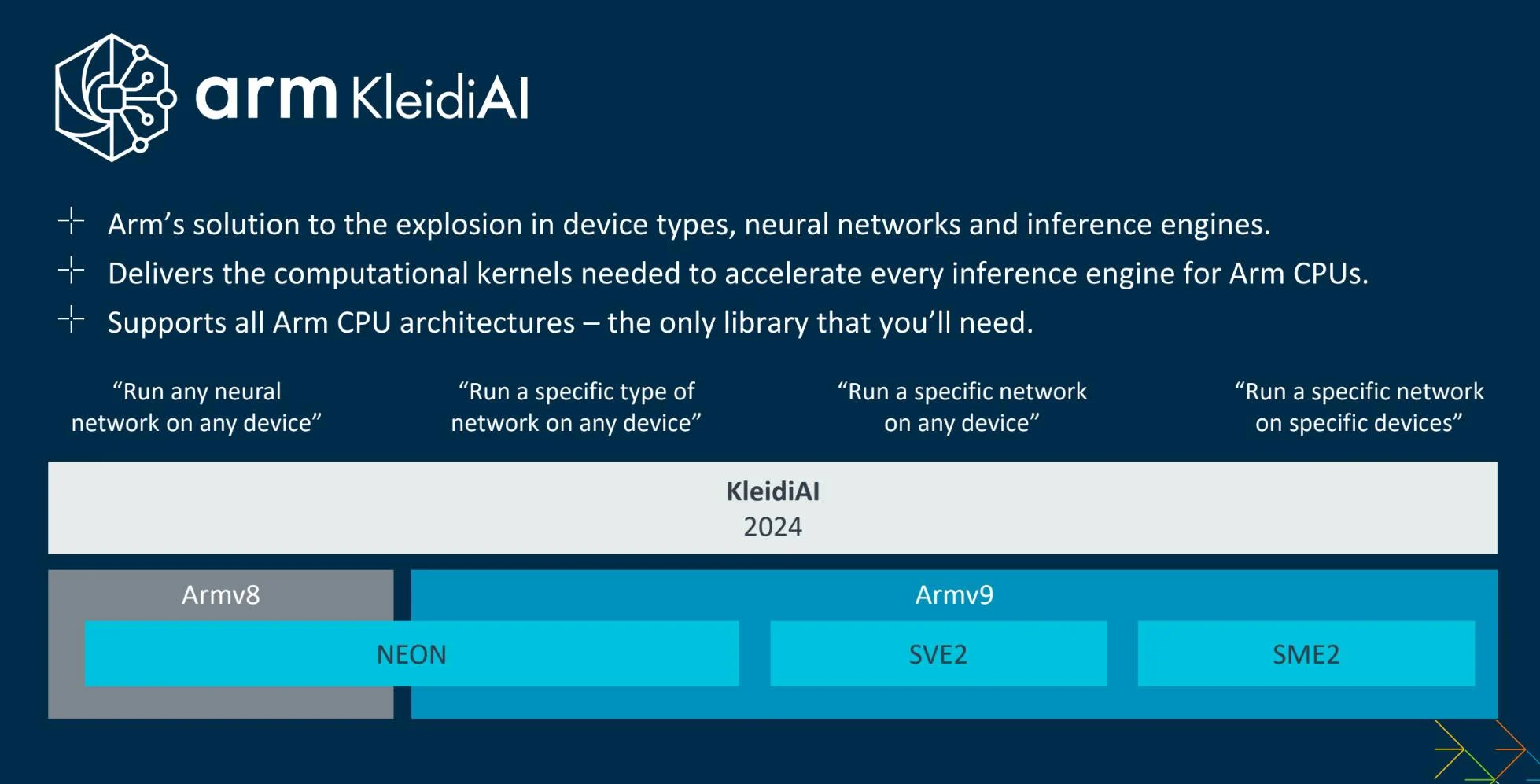
Specifically, we're talking about Armv9's Scalable Matrix Extension (SME2) (opens in a new tab) as well as its Scalable Vector Extension (SVE2) (opens in a new tab) instructions.
Apple M4 chips use Armv9 + SME2
Arm really wants chip designers to migrate to using Armv9, which brings in more neural network acceleration on the CPU side. And that's kinda why Arm has this beef with Qualcomm, which is sticking to Armv8 (with NEON) and custom NPUs for its latest Nuvia-derived Snapdragon system-on-chips. You've got the likes of Apple on one side using Armv9 and SME2 in its latest M4 chips, and Qualcomm and others on the other side persisting with NPUs. Arm would be happier without this fragmentation going forward.
And so that brings us to KleidiAI (opens in a new tab), a handy open source library (opens in a new tab) Arm has made available, is still developing, and is said to be upstreaming to projects like the LLM inference driver Llama.cpp (opens in a new tab), that provides a standard interface to all of the potential CPU-level acceleration available on the modern Arm architecture. It's best illustrated with this briefing slide:
Bringing KleidiAI QB4 Kernels to ExecuTorch (opens in a new tab)